Second Amendment to the US Constitution - “A well-regulated Militia, being necessary to the security of a free state, the right of the people to keep and bear Arms, shall not be infringed.”
Article 1, Section 24 of Washington State’s Constitution states, in part: “The right of the individual citizen to bear arms in defense of himself, or the state” shall not be impaired...”
The Washington State Legislature, along with the governor are systematically eliminating your constitutional rights through anti-gun bill legislation
Gun owners and gun club members need to become directly involved in protecting your constitutional rights!!!
Summary of The Washington State Legislative Process
One WA State Senator represents a Legislative District
Two WA State Representatives represent a Legislative District,
There are 49 Legislative Districts in WA State
Legislature has 2 houses or chambers (House of Representatives & Senate)
Members of the House or Senate offer legislation or bills for consideration. Once a member introduces a bill, the legislative process begins
Legislative cycle is 2 years long (biennium). Regular sessions are mandated by the State Constitution and begin the second Monday each year in January. In odd numbered years, the session is 105 calendar days & in even numbered years is 60 calendar days
Carry Over – Bills from the previous session are reintroduced and retained in their present position and can be taken up again during the biennium
Public testimony, both in support or opposition to a bill is allowed for. Input may be submitted to a legislative committee either orally or written. You may also sign in at the Washington State Legislature’s website and simply indicate your support or opposition to a bill by checking the box as either support or oppose. As legislation moves through various committees, public testimony needs to be resubmitted!!!
You may contact your district senator or representatives indicating your support or opposition to a bill
U.S. Senators and U.S. Representatives perform their legislative work in Washington DC. State Senators and State Representatives do their legislative work in Olympia.
Do not write U.S. Senators or U.S. Representatives about Washington state bills. Likewise, do not write State Senators or State Representatives about federal bills.
WSP can raise the background check fee above $18 per transaction
Sponsor: Nobles (Democrat-28)
DIED
Taking action on a bill
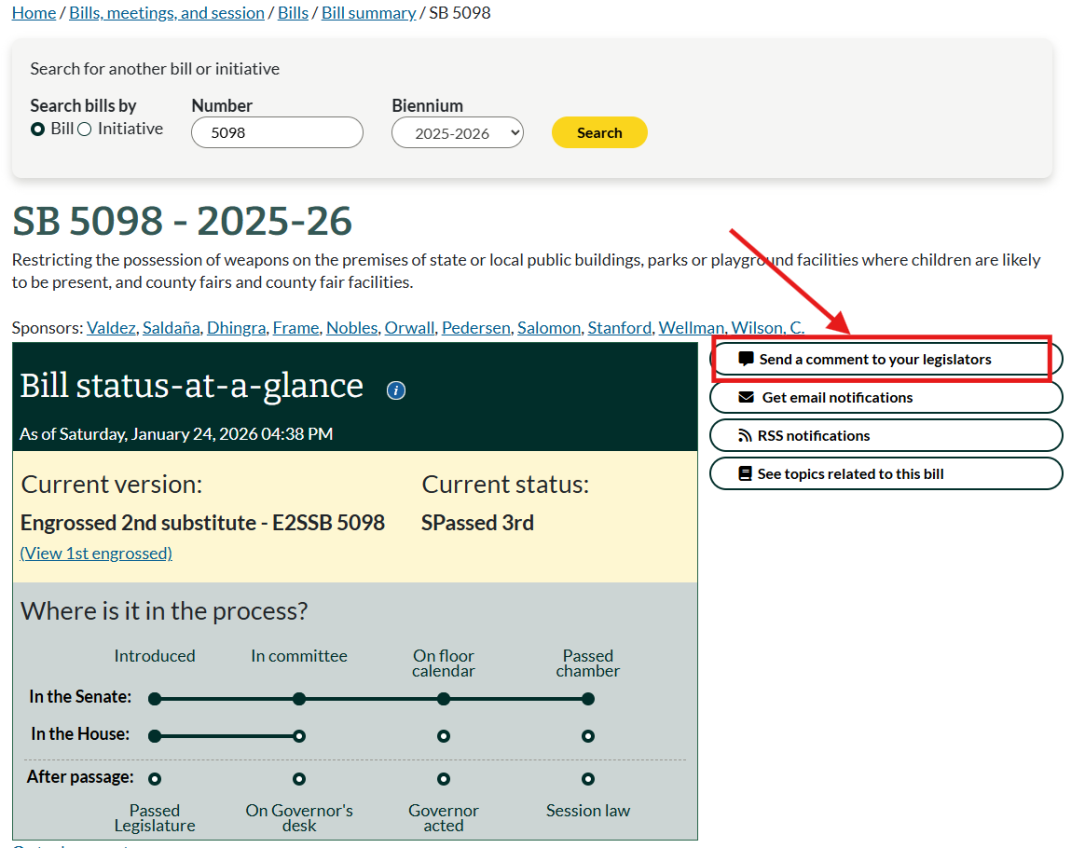
To comment on a bill
Click on a bill number above you would like to comment on
Once on the site, click on the button "Send a comment to your legislators" on the right side of the page
Fill out the form
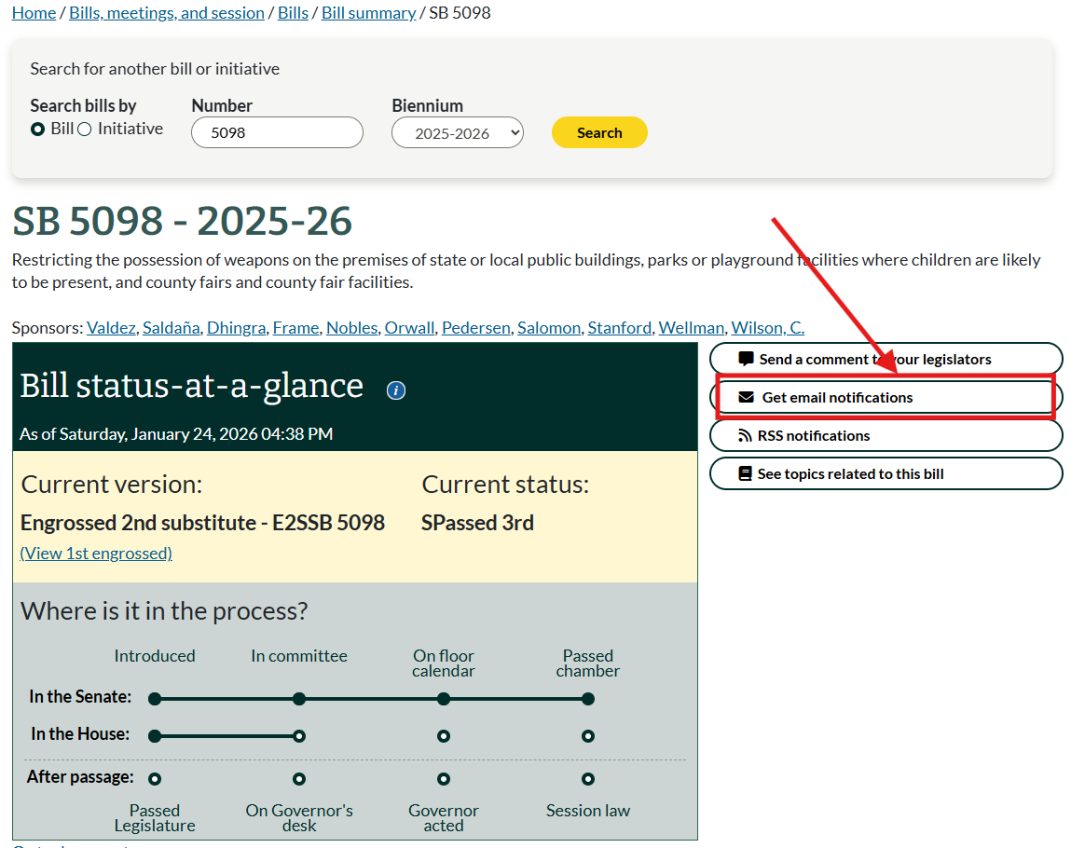
To get email updates on a bill
Click on a bill number above you would like to receive updates on
Once on the site, click on the button "Get email notifications" on the right side
Fill out the form
How to talk to talk to your State Legislatures
There are several ways that state legislators can be urged by concerned citizens to support a citizen’s right to own firearms and the Second Amendment: personal visits, testimonies at public hearings, telephone calls, letter writing, emails, social media, and rapid communication.
Click on a section below for more information
Take every opportunity to educate your legislators. Visit legislators at the State Capitol. Some have district offices located within their districts. They may have more time to talk and can relate to you as a constituent.
Important Information to be prepared for a successful meeting:
Make an appointment. Do not just show up. They may not be there or have other appointments scheduled. Ask how much time you get for the meeting. Do not assume you have all the time you want. Their schedules are busy.
Offer an online appointment if that is preferable. Ask which format they use (Zoom, Teams, etc.) Have them send a link to you.
Research information about your legislator, especially their voting record and their stand on 2A issues.
Have a goal. What do you want to accomplish during the meeting?
Be aware of your appointment time and show up on time! Be prepared for delays if something comes up on the legislator’s schedule.
Dress respectfully. First impressions are important and may determine if the legislator hears you throughout the meeting. People judge books by their covers.
Be positive, brief, specific, and concise. Prepare an outline to stay on target.
Let your legislator speak. Listen to what they have to say. Take notes. Do not record unless they give permission. Respond to questions if asked. If you do not know the answer, admit it and indicate that you will find the answer and get back to them and help to build a relationship.
If you have useful statistics or data, bring them to your meeting and leave a copy for the legislator. Always cite the source of the data. Ask how to get them useful information in the future to help educate them on the issues.
Be respectful, not rude, sarcastic, or threatening. Do not burn a bridge. If your legislator does not come around on your side this time, they may in the future.
Thank them for their time. Leave a business card with a note on how to vote on the specific bills.
Send a thank you note and reiterate your position again.
Ongoing contact is needed to encourage support for the 2A and firearm ownership. Or to educate an opponent to our issues. The other side is constantly in contact. Our side has been complacent and that is why we are seeing more anti-legislation.
Public Hearings are scheduled for specific proposed bills by the committee that oversees that type of bill. For example, with firearm legislation, the main committees that oversee firearm legislation are:
House: Civil Rights and Judiciary Senate: Law and Justice
A public hearing is an excellent opportunity to have your voice heard about a specific bill. Being prepared in advance will help you to get your point across. There is typically only one opportunity for a bill hearing so use your time wisely and make your message count.
A. Preparation
Prepare your speech in advance.
Prepare for 2 minutes but be flexible to reduce time if the committee instructs less or prepare to add time if the committee instructs that you can have more time.
Be on point and talk about the specific bill being presented. This is not the time to talk about another bill, vent frustrations or some other topic. The chair of the committee will stop you if you are off topic and have you speak about the specific bill.
It is alright to use emotion or personal experiences.
Practice your speech several times to make sure you are getting in your point during the two minutes. The chair of the committee will stop you if you exceed the allotted time.
Do not spend a lot of time in the beginning with introductions and salutations. Two minutes goes by fast so do not waste it on that. I typically state my name and the county that I live in. Briefly say the bill number and whether you are for or in opposition to the bill. I will say a thank you at the end if I have time. Occasionally they will call people up for several bills at one time that are related. In that event say you are speaking against/for and the specific bill number or if you speak in opposition to all.
Legislative hearings are televised and recorded. Do not say anything that can be used against you at any time.
Provide enough written copies of your speech for the committee plus extra copies for the minutes. If you are not able to say everything you want, putting it in written form will get your entire message to the committee members. Put your name, contact information and legislative district on there so they can get in contact with you if needed. MUST BE SENT ELECTRONICALLY (2024)
If you can bring data, facts, and articles that you are referring to, this may help the committee in deciding about a bill. Email copies to the committee plus extra copies sent to the person preparing the minutes. Please write your name, contact information, and bill number it pertains to. They may want to ask you follow up questions.
Be ready if your name is called to speak. All committee hearings have specific start and stop times. Being on time ensures that everyone who would like to speak gets an opportunity. They typically call groups of three people at a time to speak in favor or oppose a bill.
If you are testifying via online, ensure that all your equipment is working. Be prepared and sign in ahead of your scheduled time.
Be respectful of the other side and the committee members. The press may be in the room, and they observe everything that we do.
You must sign in ahead of time to be considered. Sign in is only electronically.
You can sign in on a web enabled device while connected to the legislature’s Wi-Fi or sign in at one of the Kiosks in the main lobby of the building where the hearing is being conducted.
C. Prepare A Written Testimony (If you cannot testify in person or via online)
Use same principals as in the public testimony above.
Go to the specific bill. On the menu click on: Send A Comment On This Bill To Your Legislator and follow the directions.
You may prefer to call your legislator because of work obligations, geography, or other matters that prevent you from visiting the legislator in person. Be prepared that you will most likely talk with an aide.
Important Information to prepare for a successful call:
Always call during normal business hours 9AM – 5PM. Be prepared that your legislator may call back at any time during the day or evening. Answer your phone! Answer your phone respectfully!
The contact numbers can be found: Legislative Hotline: 1.800.562.6000 Or on the web site at: http://leg.wa.gov/
Identify yourself, State your business clearly
Identify a bill number and title that you are calling about.
Have note in front of you to stay on target with your message.
Listen carefully. Answer questions that you can and get back to them if you do not have an answer.
Thank them for their time and consideration.
Follow up with a clear, concise, brief letter restating your points, especially if you speak to an aide and not the legislator.
Most legislators keep a file on every bill and review it when the bill comes to the floor for a vote. The legislator may read a well-written letter during committee hearings or floor debates. Persuasive letters may determine how a legislator votes on a bill. Beginning in 2020 they prefer electronic letters. ALL LETTERS MUST BE ELECTRONIC NOW.
Suggestions:
Write on personal or business letterhead (with employer approval).
Identify your topic immediately.
If you write about a specific bill, refer to it by number and subject.
Confine your letter to a single issue and a single page.
Explain why you support or oppose a particular issue so that if amendments are proposed, the
legislator will know their effect on your position.
Back your position with reliable facts, figures, and personal experience.
Include favorable pro-articles and editorials.
Be clear, concise, and reasonable.
Do not make threats. You may need that legislator for another matter.
Be yourself. Use your own words. Avoid stereotyped phrases and sentences that give the impression of form letters.
Write your legislator while a bill is in committee or just before a vote is taken.
Always sign your name legibly. Include your return address in your letter in case the envelope is discarded.
Check the spelling of your legislator's name and address them properly (The Honorable...).
Thank your legislator if they votes to your rights. They will know that you are aware of his voting record.
Be persistent. Do not be offended by a negative answer from your legislator. Write again and get others to write. A legislator’s mind can be changed!
Email: Email is an excellent source to get information quickly and in large numbers. Remember to include your physical address so your legislator will know you live in their district. ELECTRONIC COMMUNICATION IS THE ONLY WAY THEY WANT TO RECEIVE CORRESPONDENCE NOW.